


For many small businesses, a single lawsuit is a death sentence.
For a small business owner, the letter usually arrives via certified mail. You open it, expecting a bill or a permit renewal. Instead, it is a federal lawsuit. You are being sued for thousands of dollars because your bathroom mirror is too high, or your grab bar is off by a fraction of an inch.
You haven't been given a warning. You haven't been given 30 days to fix it. You are simply being told to pay up.
This is the "ADA Shakedown." While the Americans with Disabilities Act (ADA) was written with the noble intent of inclusion, it has been weaponized by serial litigators who treat the legal system like a slot machine. The most infamous among them, Scott Johnson, filed thousands of lawsuits against small delis, restaurants, and shops—often owned by immigrants—driving many out of business before being sentenced to prison for tax evasion.
However, the predatory ecosystem he helped build remains. "Drive-by" lawsuits are still a massive threat to small businesses. This guide explains the legal landscape, the "Inspection Gap," and the critical areas you must audit to protect your livelihood.
The Legal Landscape: Why "Notice & Cure" Has Failed
Common sense suggests that if a business makes a mistake, they should be told about it and given a chance to fix it. In the legal world, this is called a "Notice and Cure" period.
Unfortunately, the ADA generally does not require this. Under current federal law, a plaintiff can sue you immediately upon finding a violation. They are not required to warn you first.
The Fight for Legislative Change
There have been attempts to fix this. Legislation like the ADA Education and Reform Act (H.R. 620) was introduced to require a "notice and cure" period. The bill proposed giving business owners 60 days to respond to a complaint and an additional 120 days to fix the issue before a lawsuit could proceed.
However, these bills have faced stiff opposition and have stalled in Congress. Opponents argue that businesses have had over 30 years to comply with the ADA and shouldn't need more time. While valid in theory, this ignores the reality of complex, shifting building codes that trip up even well-intentioned owners.
The Takeaway: You cannot wait for Congress to save you. You must act now.
The "Inspection Gap": Why Your Business License Won't Save You
The most common reaction we hear from business owners is: "But the City gave me a business license! They inspected the building! If I was non-compliant, wouldn't they have told me?"
No. This is the dangerous "Inspection Gap."
When a city building inspector walks through your tenant space, they are primarily looking for:
- Fire Safety (Extinguishers, exits)
- Electrical Hazards
- Health Code Violations (if you serve food)
They are rarely measuring the precise height of your toilet paper dispenser or the turning radius of your sink with a tape measure. Receiving a business license is NOT a certification of ADA compliance. It simply means you are allowed to open your doors—and potentially open yourself to a lawsuit.
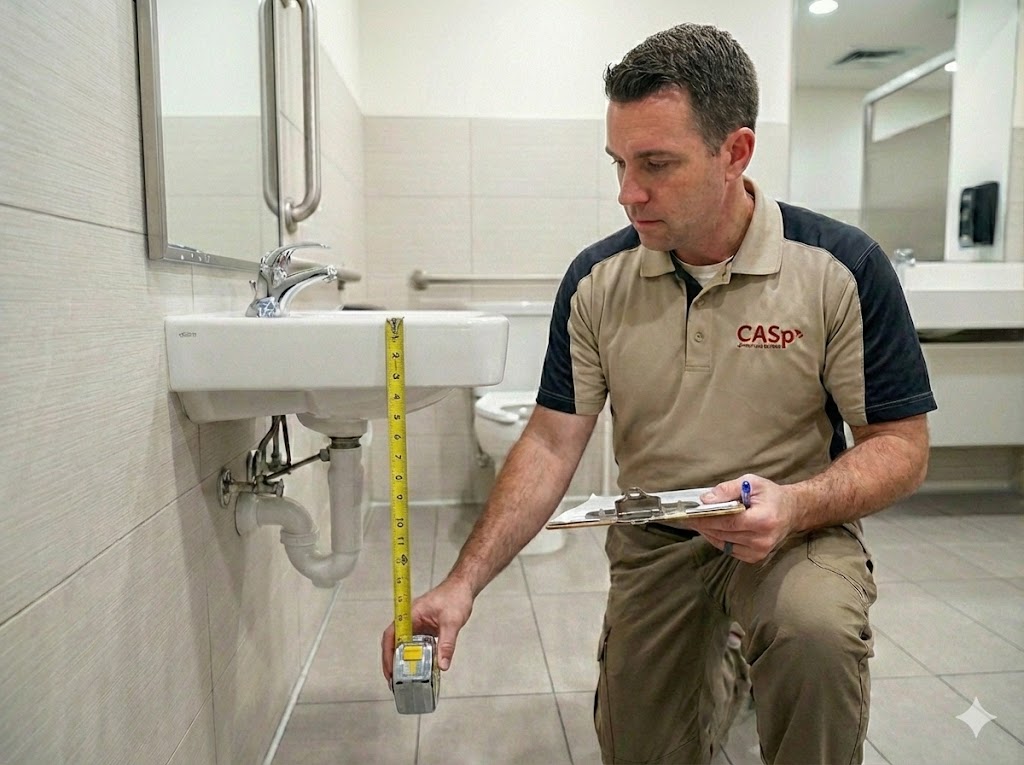
A CASp inspection is your best insurance policy.
The Proactive Solution: Hiring a CASp Inspector
If you are opening a new business or leasing an older building, do not rely on your contractor's word. Hire a Certified Access Specialist (CASp).
A CASp is a professional who has passed specific examinations and has been certified by the state (specifically in California) to inspect buildings for compliance with construction-related accessibility standards.
Why spend the money?
In states like California, hiring a CASp offers you unique legal protections. If you have had an inspection and are working on a timeline to fix the issues, you may qualify as a "Qualified Defendant." This status can:
- Grant you a 90-day stay (pause) on any lawsuits filed against you.
- Significantly reduce the statutory damages you might have to pay.
- Show the court that you are acting in good faith, not negligence.
Common "Gotcha" Areas to Watch For
While we are not ADA experts and cannot provide legal advice, we often see businesses fail because of simple oversight in fixture placement. Here are the critical areas you should review with your inspector.
1. Dispenser "Reach Ranges" & Location
The Issue: Installing a dispenser directly above the grab bar is one of the most common violations. This forces a user to reach over the bar, which is often prohibited.
What to Check: Ensure your toilet paper dispenser is within the specific reach ranges outlined in the 2010 ADA Standards (typically measured from the front of the toilet to the centerline of the dispenser). Also, verify that the operation does not require "tight grasping or pinching."
2. Mirror Mounting Height
The Issue: Contractors often install mirrors at "standing height" for an average adult, forgetting about wheelchair users.
What to Check: Verify the height of the bottom edge of the reflecting surface. If it is too high, a seated person cannot see themselves. Tilted mirrors or full-length mirrors are often used to solve this.
3. Under-Sink Clearance
The Issue: Exposed plumbing pipes under a sink can burn or abrade the legs of a wheelchair user.
What to Check: Ensure that all water supply and drain pipes under accessible sinks are insulated or covered with a protective guard to prevent contact.
The Vandal Stop Strategy: Balancing Compliance & Durability
At Vandal Stop, we manufacture fixtures that can be part of an ADA-compliant restroom when installed correctly. However, product selection requires strategy, especially when dealing with vandalism.
The "Free Flow" Requirement
One critical ADA requirement for toilet paper dispensers is that they must allow for continuous paper flow. They cannot restrict the amount of paper dispensed.
The Dilemma: In schools and parks, unrestricted paper flow often leads to vandalism—kids pulling out 50 feet of paper to clog the toilet. To combat this, we offer "Anti-Clog" dispensers that restrict paper usage.
The Strategy: In a multi-stall restroom, not every stall must be ADA compliant. Typically, only the designated accessible stall (the large one) requires the "Free Flow" ADA dispenser. The standard stalls can often be outfitted with restrictive, high-security dispensers to prevent clogging and waste. This allows you to meet the law while still protecting your plumbing.
It's All About Installation
Remember: An ADA-compliant product is only compliant if it is installed correctly.
You can buy the most advanced, accessible grab bar on the market, but if your contractor mounts it two inches too high, you are non-compliant. We provide the hardware, but your architect and contractor must ensure the placement meets the current 2010 ADA Standards.
⚠️ Important Disclaimer
Vandal Stop are manufacturers, not attorneys or ADA consultants. The information provided in this article is for educational purposes only and does not constitute legal or professional engineering advice. Building codes vary by state and municipality. We strongly recommend that every business owner hire a CASp (Certified Access Specialist) or a qualified architect to audit their specific facility for compliance.
Equip Your Restroom
We offer a full line of heavy-duty fixtures designed with accessibility requirements in mind.